ISSR CLASSES
Checkpoint Science
iGCSE Chemistry
iGCSE Physics
iGCSE Coordinated Science
A-Level Chemistry
PRACTICALS
Practicals Home
Practicals A-Z
Study Plan for Practical Work
Solubility and pH of phenol
When phenol is added to water it forms oily drops at the bottom of the mixture and the water becomes weakly acidic (about pH 6). We would expect phenol to have some solubility because of hydrogen bonding between the water and the OH group of the phenol. However, this will be limited by the relatively large hydrophobic, hydrocarbon group. Some water also dissolves in the phenol, and this explains why the phenol becomes a liquid. Phenol has a fairly low melting point (40 ºC) and the presence of a small amount of water, as an impurity, lowers the melting point below room temperature.
|
|
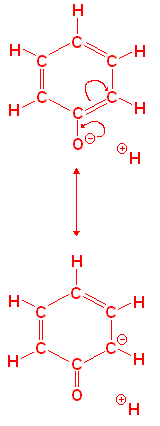
Whilst phenol is a very weak acid, it is a stronger acid than the alcohols (they are neutral) which have the same OH group in them. This is because when a hydrogen ion is lost from the OH in the phenol, the negative charge left behind on the oxygen atom can be delocalised in the ring. Spreading this charge out makes it easier for the hydrogen ion to escape, and so the phenol has an acidic nature. We saw in the acidity of carboxylic acids that delocalisation of the anion charge spread it equally over the two oxygen atoms. You might imagine that delocalisation would be more efficient over the large benzene ring, but this is not so. In the carboxylic acids, the symmetry of the situation meant the charge was equally shared over both oxygen atoms. In benzene, the negative charge has to be shared over the carbon atoms of the ring (see diagram on the left). Carbon atoms have less attraction for electrons than oxygen atoms do. Consequently, most of the negative charge remains on the oxygen atom, and it is less easy for the hydrogen ions to escape from this anion. Phenols are generally weaker acids than carboxylic acids. Other phenols may be more or less acidic than phenol itself depending on the other group(s) attached to the benzene ring. |