ISSR CLASSES
Checkpoint Science
iGCSE Chemistry
iGCSE Physics
iGCSE Coordinated Science
A-Level Chemistry
PRACTICALS
Practicals Home
Practicals A-Z
Study Plan for Practical Work
Theory of organic acid acidity
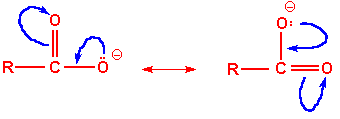
Not surprisingly, carboxylic acids are acidic! They are weak acids as they are only partially ionised in solution. For example, 0.1M ethanoic acid is about pH 3 which means only about 1 in 100 acid molecules is ionised. Their acidity is due to the delocalisation of the acid anion charge over the two oxygen atoms:
|
|
You should see that these two ions are identical, and so the real structure is exactly in between these two extremes. This means that there is only half a negative charge on each oxygen atom. This makes it relatively easy for the H+ ion to escape from the oxygen atom to which it was attached.
Anything in the acid molecule that further spreads out and reduces the negative charge on the oxygen anion will make it even easier for the hydrogen ion to escape. This would make the acid stronger. In the acids that we have looked at you should have found the following pH values:
|
Acid |
pH |
You will see that the acids containing chlorine are more acidic than the parent ethanoic acid. This is because the chlorine atom is highly electronegative. This means that it will withdraw electron density from the oxygen anion, making the molecule more acidic as the hydrogen ion escapes more readily from the less negative oxygen atom. Clearly, the more chlorine atoms present, the greater this effect will be, and the more acidic the molecule will be. |
|
|
ethanoic |
2.9 |
||
|
chloroethanoic |
2.0 |
||
|
dichloroethanoic |
1.3 |
||
|
trichloroethanoic |
1.1 |