ISSR CLASSES
Checkpoint Science
iGCSE Chemistry
iGCSE Physics
iGCSE Coordinated Science
A-Level Chemistry
PRACTICALS
Practicals Home
Practicals A-Z
Study Plan for Practical Work
Recrystallization
This process is used to purify solids.
|
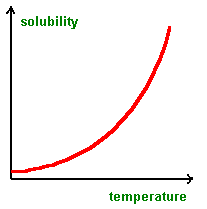
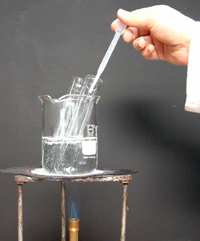
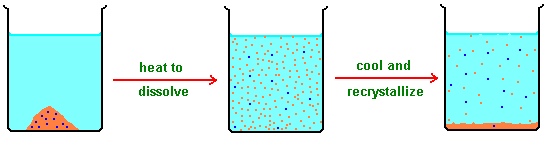
We must find an appropriate solvent, or mixture of solvents, in which our solid product must dissolve. However, it must be significantly more soluble in the hot solvent than in the cold solvent. You will usually be told which solvent(s) to use. Having made our crude product, we then dissolve it in the minimum quantity of hot solvent. This will normally involve the use of a hot water bath. The solvent is added in small amounts from a dropping pipette until the solid just dissolves. |
|
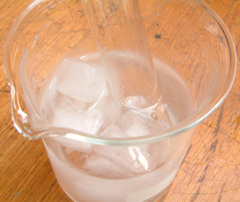
If any insoluble impurities remain, these must be removed by hot filtration. This is an awkward procedure, which involves filtering the hot solution through a heated filtration apparatus, so that it does not cool and crystallize our product. The hot solution is now allowed to cool. Our product recrystallizes, and the process can be finished off in an ice bath.
The crystals are separated from the solution by suction filtration, and washed with a little cold solvent. Drying is achieved by allowing the suction filtration to continue to draw air over our sample for a few minutes, and finished in a vacuum desiccator.
The principle behind this technique relies on our product making up the majority of the crude sample. This means that the product cannot dissolve fully in the quantity of cold solvent used, and most of it recrystallizes on cooling. However, any impurities, being only in small amounts, will remain dissolved in the solvent, and be washed off by the cold solvent. Some product will remain dissolved in the cold solvent, and will, therefore, be lost. Each recrystallization results in a loss of yield, but an improvement in quality.
|
|
Low or zero yield. You must add the minimum quantity of hot solvent, otherwise on cooling your product will remain dissolved or little solid will recrystallize. Add a small amount of solvent to the solid to start with and allow time to heat up. Then add small amounts of additional solvent with a dropping pipette until the solid just dissolves. If too much solvent is added you will have to keep it hot in order to evaporate off the excess solvent. |
|
Boiling tube breakage in water bath. You may use a boiling tube in a water bath to heat your recrystallization mixture. If you use a glass rod to encourage solution, do so very carefully. It is easy to put a hole in the bottom of the boiling tube and all your product will be lost into the water bath. |
|
|
|
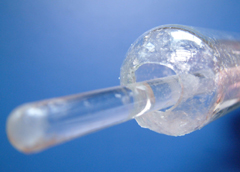
Crystals fail to form. Ensure that your solution has been thoroughly cooled in an ice bath. If crystals have still not formed, try scratching the base of the beaker gently with a glass rod. Very small pieces of glass are scraped off which act as centres for crystal growth. Alternatively, a few small product crystals (seed crystals) can be added to the solution to start crystallization. |
An oil (liquid) separates rather than crystals. Heat the solution until the oil dissolves. Allow to cool again, and as soon as oil droplets re-appear stir vigorously until crystals start to form.
|
Small crystals. Rapid cooling produces small crystals. For good quality crystals, cooling should be slow. If time allows, let the hot solution cool naturally before finishing off in an ice bath. The pictures on the right (place your mouse over the image) show crystals obtained by cooling immediately in an ice bath and by natural cooling. You should be able to work out which is which, and which is better. |
|
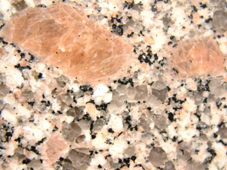
The same effect is seen in the geological world. The following pictures show two different minerals with pink crystals of feldspar within them. The one on the left formed by slow cooling, whereas the one on the right formed by more rapid cooling. You can see the effect on the crystal size.
 |
 |