ISSR CLASSES
Checkpoint Science
iGCSE Chemistry
iGCSE Physics
iGCSE Coordinated Science
A-Level Chemistry
PRACTICALS
Practicals Home
Practicals A-Z
Study Plan for Practical Work
|
|
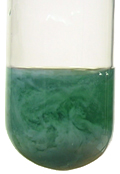
The aqueous chromium(III) ion, [Cr(H2O)6]3+, is green. |
|
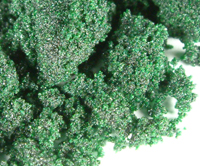
Addition of sodium hydroxide solution gives a light green, gelatinous precipitate of chromium(III) hydroxide. This precipitate is soluble in excess alkali giving a green solution of a salt known as a chromite: |
|
|
Cr3+(aq) + 3OH-(aq) ⇒ Cr(OH)3(s) |
|
Cr(OH)3(s) + 3OH-(aq) ⇒ [Cr(OH)6]3-(aq) |
You should see that these reactions are similar to those of aluminium. They are, perhaps, better seen as deprotonation reactions of the original hexaquo complex:
|
[Cr(H2O)6]3+(aq) + 3OH-(aq) ⇒ Cr(H2O)3(OH)3(s) + 3H2O(l) |
The same light green, gelatinous precipitate of chromium(III) hydroxide is formed on addition of ammonia solution (ammonia solution is alkaline as it produces hydroxide ions in aqueous solution). However, it is not dissolve rapidly in excess ammonia. A very slow reaction eventually produces deep violet ammino complexes.
It is possible to oxidise a green chromium(III) solution producing a yellow solution of chromate(VI), CrO42-(aq). There is no reaction with iodide ions.