ISSR CLASSES
Checkpoint Science
iGCSE Chemistry
iGCSE Physics
iGCSE Coordinated Science
A-Level Chemistry
PRACTICALS
Practicals Home
Practicals A-Z
Study Plan for Practical Work
|
|
Aluminium salts are generally colourless in aqueous solution. As a result of the highly charged ion, deprotonation takes place and solutions are acidic: |
|
|
[Al(H2O)6]3+(aq) |
|
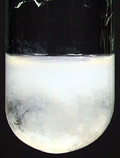
Addition of sodium hydroxide solution causes further deprotonation and gives a gelatinous white precipitate of aluminium hydroxide. This precipitate is soluble in excess sodium hydroxide solution due to the formation of a soluble aluminate: |
|
|
[Al(H2O)6]3+(aq) + 3OH-(aq) ⇒ Al(H2O)3(OH)3(s) |
|
Al(H2O)3(OH)3(s) + OH-(aq) ⇒ [Al(H2O)2(OH)4]-(aq) + H2O(l) |
Addition of ammonia solution gives the same white precipitate of aluminium hydroxide (ammonia solution is alkaline as it produces hydroxide ions in aqueous solution). No ammino complex forms so the white precipitate it is not soluble in excess ammonia.
There is only one oxidation state of aluminium so it cannot be oxidized and is unaffected by iodide ions.