ISSR CLASSES
Checkpoint Science
iGCSE Chemistry
iGCSE Physics
iGCSE Coordinated Science
A-Level Chemistry
PRACTICALS
Practicals Home
Practicals A-Z
Study Plan for Practical Work
The stability constant for a complex ion is simply an equilibrium constant. The equilibrium being the ligand exchange reaction between the aquo complex and the complex concerned. For example, the following equilibrium shows the formation of the tetramminocopper(II) complex ion in the ligand exchange reaction with the tetraquocopper(II) ion:
|
Cu(H2O)42+(aq) +
4NH3(aq) |
and the stability constant, K, would be:
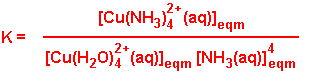
You need to remember that the concentration of the water is essentially constant, so does not appear in the equilibrium law expression.
The log of the stability constant is often given, as this is a more convenient number. A large stability constant for a complex indicates that this complex will predominate over the aquo complex. That is, it gives an indication as to the stability of the complex. When a central metal ion is competing for two sets of ligands, the complex with the highest stability constant will be the one which forms. The following list of copper complexes should enable you to predict what observations should be made during the practical work. For example, if edta is added to the lime green chloro complex, the solution will turn sky blue. This is because the edta complex is more stable than the chloro complex, and a ligand exchange reaction takes place forming the edta complex. However, if chloride ligand is added to the sky blue edta complex, then no change will be seen, other than dilution, as the chloro complex is less stable.
|
Ligand |
colour of complex |
lg K |
|
Water |
blue |
0 |
|
Chloride |
lime green |
5.6 |
|
Ammonia |
royal blue |
13.1 |
|
edta |
sky blue |
18.8 |
 Cu(NH3)42+(aq) +
4H2O(l)
Cu(NH3)42+(aq) +
4H2O(l)