ISSR CLASSES
Checkpoint Science
iGCSE Chemistry
iGCSE Physics
iGCSE Coordinated Science
A-Level Chemistry
PRACTICALS
Practicals Home
Practicals A-Z
Study Plan for Practical Work
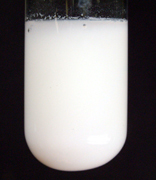
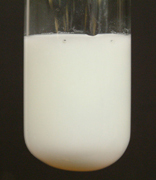
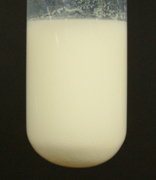
You should have observed the following three colours of precipitates:
|
|
|
|
|
silver chloride - white |
silver bromide - cream |
silver iodide - pale yellow |
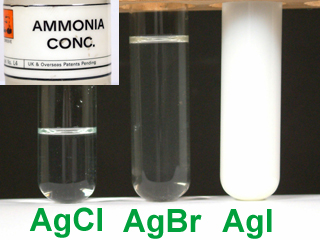
You should notice that the colours aren't particularly different, so it helps to have a further test to distinguish them. We use the solubility in ammonia solution. Again you need to remember the results:
|
|
Silver chloride is soluble in dilute or concentrated ammonia solution Silver bromide is sparingly soluble in dilute ammonia, but dissolves in concentrated ammonia Silver iodideis insoluble in either dilute or concentrated ammonia solution |
The final point of interest is that the silver halides are affected by light. The photochemical reaction produces metallic silver which changes the precipitate colour. Consequently, they are used in some photographic materials. More memory required here. Place your mouse over the images to see the effect of brief exposure to light:
|
|
|
|
|
AgCl - goes purple |
AgBr - goes green |
AgI - no visible effect |
In order to form a precipitate we need to mix two solutions - one containing the silver ions and the other containing the halide ions. You should understand the principle behind precipitation, and be able to write full and ionic equations for this process. Suggest full and ionic equations for the formation of the three silver halide precipitates. Check your answers here.
In summary:
|
Precipitate |
Colour |
Solubility in ammonia (aq) |
Change in light |
|
Silver chloride |
white |
very soluble |
goes purple |
|
Silver bromide |
cream |
slightly soluble |
goes green |
|
Silver iodide |
pale yellow |
insoluble |
none observed |