ISSR CLASSES
Checkpoint Science
iGCSE Chemistry
iGCSE Physics
iGCSE Coordinated Science
A-Level Chemistry
PRACTICALS
Practicals Home
Practicals A-Z
Study Plan for Practical Work
Redox is short for reduction-oxidation.
The most common redox titration carried out at "A" level is the iodine-thiosulfate titration. A standard solution of sodium thiosulfate is used to titrate an unknown solution of iodine. The iodine is reduced to the iodide ion and the thiosulfate ion is oxidized to the tetrathionate ion. The equation shows us the link between the two reacting substances and is an essential part of the titration calculation. The following equation should be learnt:
|
2Na2S2O3(aq) + I2(aq) ⇒ Na2S4O6(aq) + 2NaI |
|
or 2S2O32-(aq) + I2(aq) ⇒ S4O62-(aq) + 2I- |
This is often written in shorthand as 2S2O32- º I2. The º means "is equivalent to". In other words, for every two thiosulfate ions there is one iodine molecule.
|
|
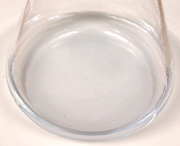
It is possible to carry out this titration without an indicator. The products of the reaction are colourless and the iodine solution is brown. The end-point occurs when the iodine has just been used up and the reaction mixture goes colourless. However, as the iodine becomes more dilute it becomes increasingly pale yellow. So the actual end-point is very pale yellow to colourless. This is possible to spot, but not easy. The addition of a few drops of starch indicator makes the end-point much clearer. It is added when the iodine has become pale yellow and it turns it blue-black. The end-point is when this just goes colourless. A drop before the colourless end-point it will look very pale blue or grey. |
|
Acidified potassium manganate(VII) is another popular standard solution for use in redox titrations. It is an oxidizing agent and can be used to oxidize a number of other substances. A common titration involves the oxidation of iron(II) to iron(III) ions: |
|
|
MnO4-(aq) + 5Fe2+(aq) + 8H+(aq) ⇒ Mn2+(aq) + 5Fe3+(aq) + 4H2O(l) |
MnO4- º 5Fe2+
The solution needs to be well acidified to provide the H+ ions shown in the equation. The acid also inhibits the oxidation of Fe2+ to Fe3+ by the air. Without sufficient acid alternative reactions take place and the link between the MnO4- and Fe2+ will be lost.
|
|
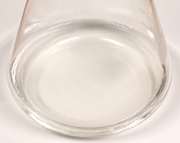
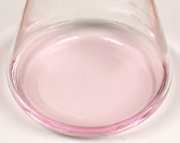
This titrant is self-indicating. This means that a separate indicator is not needed. The manganate(VII) ion is bright purple, but it is reduced to the virtually colourless manganese(II) ion (it's actually very pale pink but looks colourless). When the iron(II) is finally used up, the manganate(VII) is no longer reduced, so the purple colour remains. As the titration should have been done to the nearest drop, there should be no more than a drop of purple manganate(VII) in the titration mixture. Consequently, it does not look purple, but appears pink. The end-point is the first permanent pink colour. If you put your mouse over the first picture you will see the actual end-point - it's not easy to see! If you are not sure whether you have reached an end-point, make a note of the burette reading and add another drop of titrant. This has been done and shown in the second picture - this has definitely gone! |
|
|
|
Iron(III) concentration can also be measured using this titration. We first reduce the iron(III) solution to iron(II). This can be done using a mixture of excess zinc metal and acid. Bubbles of hydrogen will be seen given off as the zinc reacts with the acid. After reduction is complete the remaining zinc is removed by filtration. The iron(II) concentration is now measured by titration with potassium manganate(VII) solution. Fe3+ º Fe2+
2.JPG)