ISSR CLASSES
Checkpoint Science
iGCSE Chemistry
iGCSE Physics
iGCSE Coordinated Science
A-Level Chemistry
PRACTICALS
Practicals Home
Practicals A-Z
Study Plan for Practical Work
All the alcohols used in this experiment were primary alcohols.
|
|
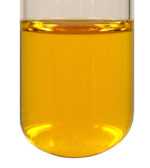
You should notice that in each case that a colour change from orange to green occurs. This is a popular exam question. When the alcohol is oxidized, the orange sodium dichromate is reduced to the green Cr3+ ion. Further reduction to the blue Cr2+ ion is possible, and so you may find that you obtain a blue solution if you do your own experiment. |
You should see that all five alcohols react in a very similar way. This is typical of a homologous series in which the reaction is that of the functional group rather than the entire molecule. You should also observe that the butan-1-ol and pentan-1-ol are immiscible with the aqueous solution, and so can be seen floating on top of the solution.
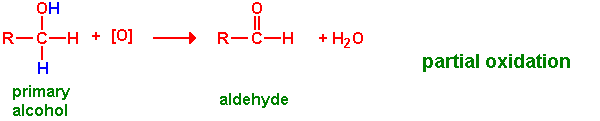
Primary alcohols are oxidized first to aldehydes and then to carboxylic acids. [O] is often used to represent the oxygen provided by the oxidizing agent, as it is easier than writing a fully balanced equation.
Stage 1
|
|
In this first stage of oxidation we see that two hydrogen atoms are lost - one from the OH group and the other from the adjacent carbon atom. If we are attempting to make an aldehyde using this reaction we must be careful to avoid the second stage of oxidation. To do this we use a limited amount of oxidizing agent, calculated to take the oxidation only as far as the aldehyde stage. We also distil out the aldehyde product as it is formed.
Stage 2
|
|
In this second stage of oxidation an extra oxygen atom is gained by the aldehyde. To ensure complete oxidation to the carboxylic acid, an excess of oxidizing agent is used. The reaction mixture is also refluxed fro some time before attempting to separate the product.
For example, with ethanol:
|
CH3CH2OH + [O] ⇒ CH3CHO (ethanal) + H2O |
|
CH3CHO + [O] ⇒ CH3COOH (ethanoic acid) |
|
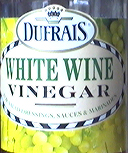
You may smell the sharp, vinegary smell of any carboxylic acid formed (ethanoic acid is found in vinegar). Alcoholic drinks go off after suffering from atmospheric oxidation, giving them a vinegary taste. In wine vinegar this process is deliberately brought about to give a cooking ingredient. |
|
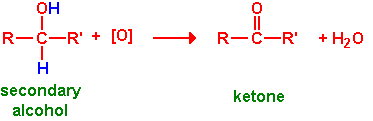
Secondary alcohols are oxidized to ketones.
|
|
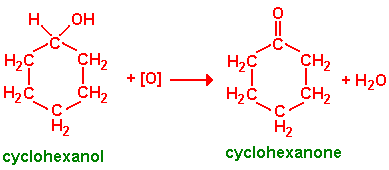
We see a similar process to that seen with the primary alcohols here, in that the hydrogen atom from the OH and the hydrogen atom from the adjacent carbon atom are lost in this oxidation. The appearance of the C=O double bond produces a ketone. Ketones are not easily oxidized, so no further oxidation is seen with secondary alcohols.
For example, with cyclohexanol:
|
|
|
Tertiary alcohols are not readily oxidized. There is no hydrogen atom on the carbon adjacent to the OH group, so it is not possible to carry out a similar oxidation to those seen with primary and secondary alcohols. |
|