ISSR CLASSES
Checkpoint Science
iGCSE Chemistry
iGCSE Physics
iGCSE Coordinated Science
A-Level Chemistry
PRACTICALS
Practicals Home
Practicals A-Z
Study Plan for Practical Work
|
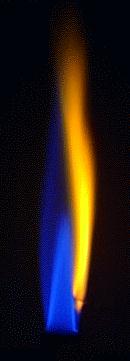
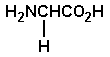
The exact optical rotation of a sample depends on a number of factors, such as concentration of the solution, path length, temperature and the wavelength of the light used. "A" level equipment usually uses white light which makes it more difficult to observe the dimmest point. More precise work uses the narrow frequencies of light from a sodium lamp. You should have discovered that the glycine solution had zero rotation, that is that it was optically inactive. This is because glycine is the only 2-amino acid we meet that has no chiral centre and so no optical activity. |
|
|
sodium light |
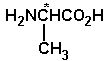
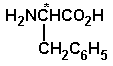
The amino acids found in nature are in the L- arrangement. You should have found that L-alanine is dextrorotatory (+), and that L-phenylalanine is laevorotatory (-). The exact rotation was dependent on the solution concentration. Also the full tube of alanine gave twice the rotation of the half full tube. This is because the optical rotation is proportional to the path length. So with twice as much solution we see twice the rotation.
|
|
|
|
|
glycine |
alanine |
phenylalanine |