ISSR CLASSES
Checkpoint Science
iGCSE Chemistry
iGCSE Physics
iGCSE Coordinated Science
A-Level Chemistry
PRACTICALS
Practicals Home
Practicals A-Z
Study Plan for Practical Work
|
|
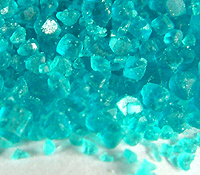
The hexaquo nickel(II) ion, [Ni(H2O)6]2+, is green in aqueous solution. |
|
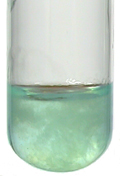
On addition of sodium hydroxide solution a green precipitate of nickel(II) hydroxide is formed. This can be represented as a simple precipitation reaction or as the deprotonation of the original hexaquo complex: |
|
|
Ni2+(aq) + 2OH-(aq) ⇒ Ni(OH)2(s) |
|
or [Ni(H2O)6]2+(aq) + 2OH-(aq) ⇒ Ni(H2O)4(OH)2(s) + 2H2O(l) |
This precipitate is insoluble in excess sodium hydroxide solution.
|
|
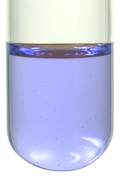
The same precipitate forms on addition of ammonia solution (ammonia solution is alkaline as it produces hydroxide ions in aqueous solution). However, in excess ammonia it dissolves due to the formation of the violet hexammino nickel(II) ion by ligand exchange. |
|
Ni(H2O)4(OH)2(s) + 6NH3(aq) ⇒ [Ni(NH3)6]2+(aq) + 4H2O(l) + 2OH-(aq) |
|
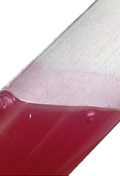
A test for nickel(II) ions involves the addition of a solution of dimethylglyoxime (butanedione dioxime). A positive test gives a bright red precipitate. |
|