ISSR CLASSES
Checkpoint Science
iGCSE Chemistry
iGCSE Physics
iGCSE Coordinated Science
A-Level Chemistry
PRACTICALS
Practicals Home
Practicals A-Z
Study Plan for Practical Work
|
|
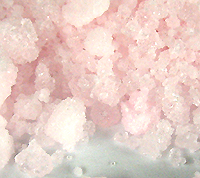
The [Mn(H2O)6]2+ ion is pale pink as can be seen from the solid compounds. However, in aqueous solution it is too pale to observe so appears colourless. |
|
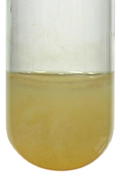
On addition of sodium hydroxide solution a white precipitate of manganese(II) hydroxide is formed. This can be represented as a simple precipitation reaction or as the deprotonation of the original hexaquo complex: |
|
|
Mn2+(aq) + 2OH-(aq) ⇒ Mn(OH)2(s) |
|
or [Mn(H2O)6]2+(aq) + 2OH-(aq) ⇒ Mn(H2O)4(OH)2(s) + 2H2O(l) |
|
|
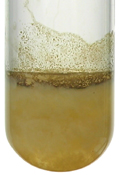
However, this white precipitate rapidly darkens in air due to oxidation to manganese(III) hydroxide. This effect is clearer at the surface where the air is in contact with the precipitate. Excess sodium hydroxide solution does not dissolve the precipitates. |
The same precipitate forms and darkens on addition of ammonia solution (ammonia solution is alkaline as it produces hydroxide ions in aqueous solution). No ammino (ammonia as ligand) complex forms so there is no change on adding excess ammonia. More pronounced darkening takes place if an oxidizing agent, like hydrogen peroxide, is added to this precipitate as brown manganese(IV) oxide is formed.