ISSR CLASSES
Checkpoint Science
iGCSE Chemistry
iGCSE Physics
iGCSE Coordinated Science
A-Level Chemistry
PRACTICALS
Practicals Home
Practicals A-Z
Study Plan for Practical Work
|
|
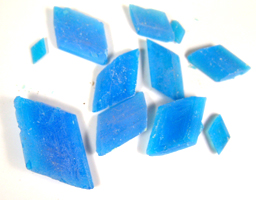
The hexaquo copper(II) ion, [Cu(H2O)6]2+, gives the familiar blue colour to copper(II) sulfate solution. |
|
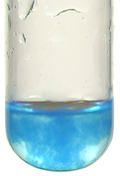
This ion can be deprotonated by the addition of sodium hydroxide solution to give a gelatinous, blue precipitate of copper(II) hydroxide: |
|
|
Cu2+(aq) + 2OH-(aq) ⇒ Cu(OH)2(s) |
|
or [Cu(H2O)6]2+(aq) + 2OH-(aq) ⇒ Cu(H2O)4(OH)2(s) |
No further reaction takes place on addition of excess alkali so the blue precipitate remains insoluble.
|
|
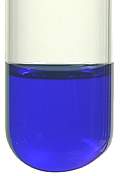
The same blue precipitate forms on addition of ammonia solution (ammonia solution is alkaline as it produces hydroxide ions in aqueous solution). However, in excess ammonia it dissolves due to the formation of the tetrammino copper(II) ion by ligand exchange. The complex is royal blue in colour. |
|
Cu(H2O)4(OH)2(s) + 4NH3(aq) ⇒ [Cu(NH3)4(H2O)2]2+(aq) + 2H2O(l) + 2OH-(aq) |
|
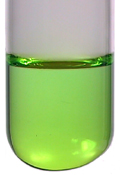
On addition of concentrated hydrochloric acid to the blue, aqueous solution of hexaquo copper(II), the solution first turns yellow, and then green. This is the result of a ligand exchange reaction which produces the blue tetrachloro cuprate(II) ion, [CuCl4]2-. The intermediate yellow colour being a mixture of the blue and green complex ions: |
|
|
[Cu(H2O)6]2+(aq) +
4Cl-(aq) |
|
|
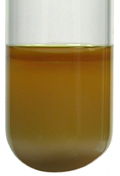
An interesting redox reaction occurs when a solution of iodide ions is added to an aqueous copper(II) salt. The iodide is oxidized to brown iodine and the copper(II) is reduced to a white precipitate of copper(I) iodide: |
|
2Cu2+(aq) +
4I-(aq) |