ISSR CLASSES
Checkpoint Science
iGCSE Chemistry
iGCSE Physics
iGCSE Coordinated Science
A-Level Chemistry
PRACTICALS
Practicals Home
Practicals A-Z
Study Plan for Practical Work
|
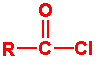
Acyl chlorides are very reactive compounds which have the general formula, RCOCl (where R represents any group of atoms). Acyl chlorides are also known as acid chlorides. |
|
|
|
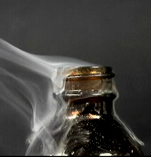
Acyl chlorides belong to a group of compounds known as acid derivatives. This is because they are prepared from carboxylic acids. An acyl chloride can be prepared by the action of phosphorus pentachloride on the corresponding carboxylic acid. They are very reactive organic chemicals. Their reactivity, along with the observation that they fume in moist air, can often be used to identify them. |
Acyl chlorides are too reactive to be found in Nature. The most common acyl chloride met in the laboratory is ethanoyl chloride (old name acetyl chloride), CH3COCl.
Acyl chlorides are named using the suffix -OYL CHLORIDE, so the name is of the form alkanoyl chloride. There is no need for any position number as acyl chloride groups can only be on the end of the chain.
Examples
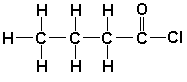
The structural formula is CH3CH2CH2COCl
This is called butanoyl chloride. The acyl chloride group can only appear at the end of a chain, so no number is necessary. The carbon atom of the acyl chloride group is also counted as one of the carbons of the chain.
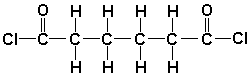
The structural formula is ClOC(CH2)4COCl
With six carbon atoms and two acyl chloride groups, the name is hexanedioyl dichloride.
|
|
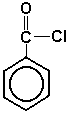
The structural formula is C6H5COCl. This is usually known by its trivial name of benzoyl chloride. The systematic name is benzene carbonyl chloride. |
|
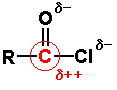
Acyl chlorides are particularly reactive, and they fume in moist air due to a reaction with water in the air. Whenever you meet an exam question which talks about an organic compound which reacts rapidly, it is usually an acyl chloride. Acyl chlorides are very reactive because the carbon atom, which is attached to both highly electronegative oxygen and chlorine atoms, is consequently very positive and therefore attracts nucleophiles strongly. |
|
They have a number of reactions, but they are all essentially the same. Hydrogen chloride gas is usually evolved. Remove the chlorine atom from the acyl chloride and a hydrogen atom from the functional group of the other molecule. Then join the two free ends of the molecules together:

We shall be looking at the reactions of ethanoyl chloride with water, ethanol and ammonia in one of the experiments.